


Addis Repoter staff reporter – Al Jazeera’s recent program “Abiy Ahmed, Eritrea & the TPLF: Mehdi Hasan & Getachew Reda | Head to Head” was marketed as a debate. It was nothing of the sort. It was not journalism either. Rather it was a meticulously planned, well-orchestrated, well-funded, politically engineered, and deceitfully executed propaganda piece designed to mischaracterize Ethiopia, vilify Prime Minister Abiy Ahmed, permanently sever Tigray from the Ethiopian state and fracture the growing political bridge between Addis Ababa and Mekelle.
Presented as a debate, the program was, in reality, a courtroom without a defense attorney. The prosecution—Hasan, panelists Tsedale Lemma and Kjetil Tronvoll—operated in lockstep, while the sole Ethiopian government voice, Bisrat Lemessa, was strategically outnumbered and sidelined. Crucially, no sitting Ethiopian government official with direct knowledge of the war and the state’s position was invited to defend the nation. The verdict was pre-scripted: Abiy Ahmed must be painted as a tyrant, a genocidaire, and an imperialist warmonger, and any bridge he has built with Tigrayan politicians like Getachew must be burned to the ground.
The Core Conspiracy: Keeping Tigray Out of Power
The entire charade was built on a foundation of six pernicious objectives:
- Demonize PM Abiy Ahmed as a genocidal tyrant, an imperialist, and a warmonger. Every word, tone, and insinuation was designed to debase him. The panel never acknowledged the political, social, and humanitarian efforts of Abiy’s government, including massive post-war reintegration support for Tigray.
- Reinforce the isolation of Tigray from federal power-sharing. Tsedale Lemma repeatedly claimed that unity was impossible and insisted that “Tigray is not part of the federation,” portraying Ethiopia as already disintegrating.
- Undermine Getachew Reda for daring to ally with Abiy and bridge that gap for it threatened the separatist agenda. His willingness to work with the federal government was framed as betrayal, implicitly isolating him from Tigray’s population.
- Use Getachew’s past rhetoric to destroy the Abiy–Getachew bridge, sabotaging Tigray’s political reintegration to the central government. Getachew was humiliated, and his past statements were weaponized against him, making him appear either a traitor to Tigray or a mere servant to Abiy. His silence during attacks on Ethiopia or Abiy’s leadership was exploited to reinforce this portrayal.
- If when these measures fail, scream “inevitable war,” creating a humanitarian-crisis narrative designed to secure international sympathy for Tigray and to pressure Ethiopia politically. In other words, to reinternationalize the Tigray crisis and justify external intervention.
- Ultimately, the overarching goal was to ensure Tigray remains a disconnected, to make Ethiopia appear ungovernable and on the verge of disintegration — the Balkanization of Ethiopia — a message repeatedly conveyed by Mehdi, Tsedale, and Tronvoll.
Hasan, Tsedale, and Tronvoll played their assigned roles perfectly. Hasan, whose respectful tone for Western leaders vanishes when confronting African ones, relentlessly debased Abiy, tossing around labels like “imperialist,” “appointee of God,” and “warmonger” without challenge. He treated Getachew not as a guest but as a hostile witness, weaponizing his past wartime statements to corner him. The goal was clear: render Getachew incapable of defending Ethiopia or its Prime Minister, because his own past as a TPLF spokesman was used as a gag.
The Panelists’ True Allegiances Exposed
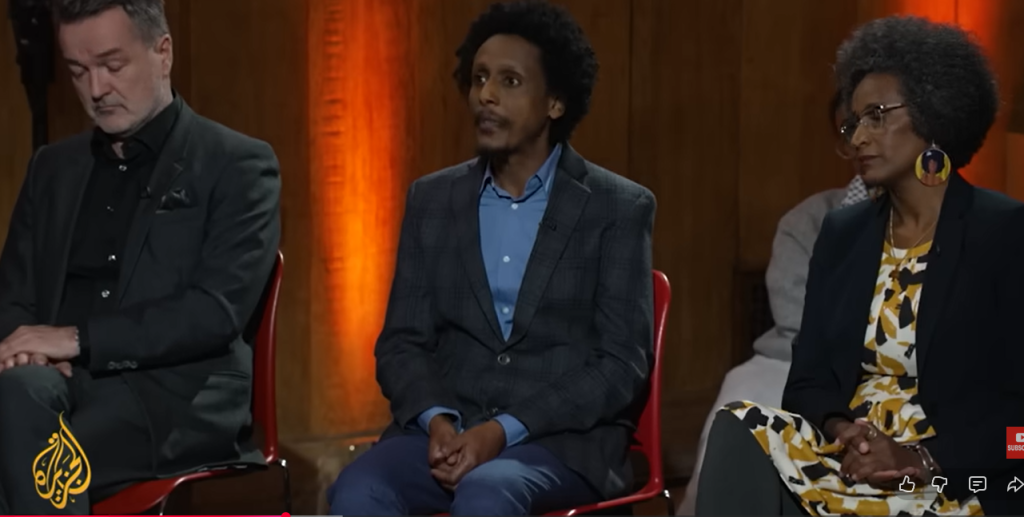
The panel was a study in biased choreography. Kjetil Tronvoll, parading as an academic, is a longtime TPLF sympathizer who has worked hand in glove with its leaders. He proudly admits to having coined the term “Tigray Defense Force (TDF)” to rebrand TPLF fighters as a legitimate national army, a blatant political act masquerading as analysis. His pronouncements were not scholarship but activism. He declared Ethiopia’s transitional justice a sham and, with disturbing eagerness, prophesied that “war is coming and coming pretty soon.” It wasn’t analysis; it was a hope.
Tsedale Lemma’s performance was even more revealing. Editor of the Addis Standard, she cried for the TPLF in the name of Tigray, claiming Abiy’s war had torn “every fabric of Ethiopian society” apart and made disintegration inevitable. Her anguish is not for Tigrayans but for a lost TPLF hegemony. She labeled Getachew “immoral” not out of concern for his people, but because his pragmatic alliance with Abiy threatens her faction’s goal of keeping Tigray as a perpetual, aggrieved outsider to manipulate Ethiopian politics. It is telling that her newspaper has extensively covered Abiy’s accusations that federal funds to Tigray are being diverted to militants—a critical point she utterly failed to raise during the show.
The Internal Fracture: How TPLF Fanatics, Not Ethiopia, Engineered Tigray’s Crisis
To grasp the current political quagmire in Tigray, one must understand the TPLF’s persistent internal divisions. After losing federal power in 2018, the group split: one faction sought a pragmatic confederal deal with Ethiopia; the other, emboldened by its military, launched the disastrous November 2020 war to reclaim Addis Ababa. This fatal miscalculation led to defeat and further factionalism.
Post-Pretoria, reformers like Getachew Reda, who called for internal accountability, were purged by hardliners refusing any reckoning. Today, these extremist elements control Tigray and are themselves fractured—between those fearing another conflict and radicals actively seeking an alliance with their former enemy, the Eritrean regime, under the reported “Tsimdo” pact. This crucial context of criminality, radicalization, and desperation for a new crisis was wholly ignored by the Al Jazeera panel.
The Glaring Omissions: A Journalistic Blackout
A program titled “Abiy Ahmed, Eritrea & the TPLF” was scandalously silent on the true architects of suffering. This was not an oversight; it was a deliberate narrative choice.
- How the War Started: Not once did Mehdi Hasan, the “impartial” host, state the unequivocal truth. The war began on November 3, 2020, when the TPLF—resentful of losing its 27-year stranglehold on power—launched pre-emptive, coordinated attacks on the Northern Command of the Ethiopian National Defense Force. Their stated goal was to defeat the army and march back to Addis Ababa. This was an armed insurrection against the state.
- TPLF Atrocities and Genocide Rhetoric: The panel wept for abstract “war crimes and genocide” but ignored specific, documented TPLF horrors by human rights organizations. Where was the mention of the massacres in Chenna and Kobo in the Amhara region, where survivors said: “First they shot my brother Taddese… My other brother and my brother-in-law tried to move away and were both shot… they shot me in my left shoulder… I pretended to be dead”; “The first dead bodies we saw were by the school fence. There were 20 bodies lying in their underwear and facing the fence and three more bodies in the school compound.… Those who were shot at the back of their heads could not be recognized because their faces were partially blown off,”? Where was the testimony from Amnesty International, where survivors like 14-year-old “Lucy” recounted being raped by Tigrayan fighters who said, “Our families were raped and now it is our turn to rape you”? Where was the discussion of TPLF’s use of child soldiers, the theft of humanitarian aid, or the sham September 2020 elections they held in defiance of the federal government as reported by Al-Jazeera? Most tellingly, TPLF leaders like Debretsion Gebremichael have themselves stated that the “genocide” rhetoric was a fabricated narrative to tarnish the federal government—a crucial contradiction the show avoided entirely.
- Eritrea’s Role, Atrocities, and the Bizarre “Tsimdo” Alliance: The show obsessed over Abiy’s rhetoric on sea access but ignored the elephant in the room: the Eritrean army’s brutal invasion of Tigray. Reports done by Commission of Inquiry on Tigray Genocide (CITG) and reported by Tsedale’s Addis Standard, indicate over 60% of atrocities were committed by Eritrean forces, infamous for systematic rape, looting, and grotesque sexual violence; and held responsible for majority of nearly USD 11 billion destruction in Tigray. The supreme, unmentioned irony is that the illegal TPLF administration now in control of Tigray has reportedly formed an alliance with this same Eritrean regime under a pact called “Tsimdo.” In a program purportedly about Eritrea and the TPLF, this monstrous hypocrisy and the entirety of Eritrea’s grievous war crimes were erased. This omission is not just disturbing; it reveals the program’s true, politicized agenda.
- The Port of Assab and Historical Grievance: The discussion on sea access was deliberately shallow. Only Bisrat Lemessa pointed out the foundational injustice: that in 1993, the TPLF-dominated EPRDF government, without any legitimate mandate or popular referendum, ceded Ethiopia’s sovereign access to the Red Sea by gifting the port of Assab to Eritrea. Ethiopia’s quest is not expansionism but a correction of this illegitimate severance. Getachew himself belittled this national cause, conflating strategic access with mere “real-estate.”
- Federal Efforts for Tigray: The narrative was one of pure federal abandonment. Yet, no one mentioned that in early 2023, the National Bank of Ethiopia began transferring 5 billion Birr to Mekelle to restore banking services. No one acknowledged that the federal budget continues to flow to Tigray, even as PM Abiy has raised legitimate concerns in parliament that these funds are being diverted to “militant activities” instead of reconstruction – again a fact reported by Tsedale’s Addis Standard.
The Insider’s Revelation: A Scripted Performance for Balkanization
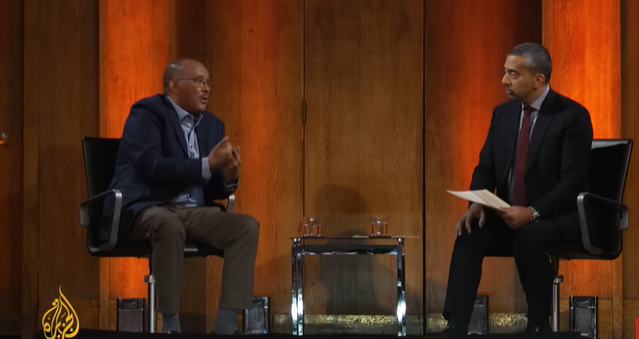
The most damning evidence comes from the lone voice who dared to break the script: panelist Bisrat Lemessa. In a post-interview on Addis Paradigm, Bisrat exposed the sinister engineering behind this “debate.”
He disclosed that Al Jazeera had extensive pre-program consultations, carefully shaping questions and the setting. He flew from the USA to London for a show where, behind the scenes, he witnessed attendees and panelists coordinating with producers. Most shockingly, a producer approached him to ask his ethnicity because “Mehdi wanted to know.” This is not journalism; it is racist profiling. It exposes the show’s malicious intent: to filter voices through a divisive ethnic lens and serve a predetermined agenda of ethnic polarization, stripping Hasan of any pretense of impartiality.
Bisrat’s most critical revelation was his exchange with the program director after the taping. Stunned by Mehdi Hasan’s granular, insider knowledge of Ethiopian factional politics—knowledge far beyond a journalist’s casual interest—Bisrat confronted her. He stated, “I am pretty sure that Mahdi cannot be aware to this extent about the details of Ethiopian politics – it is Not his interest – this must be your work.” The director’s reply was a silent admission of guilt: “You can blame me for this – you are right,” she said apologetically.
This confirms everything. The show was a hit job, written by interests committed to a vision Bisrat highlighted: the Balkanization of Ethiopia. He recalled that just days after the TPLF started the war in November 2020, a document was already being circulated in the UK parliament arguing that three new states would emerge from the conflict and that the international community should “pave the way.”
Conclusion: The War They So Desperately Need
The relentless push to paint Ethiopia as an aggressor, to decry an “inevitable” war with Eritrea, and to sever Tigray is not born of humanitarian concern. It is born of a political necessity for Abiy’s opponents. As Ethiopia approaches an election year (2018 EC / May 2026), the goal is to discredit Abiy by amplifying issues like incarcerated journalists and MPs while ignoring the TPLF’s foundational violence. Furthermore, Ethiopia is developing at a staggering pace in other regions. In a few years, the contrast between a thriving, integrated nation and a Tigray isolated by criminal, fanatical TPLF remnants will be undeniable. The people of Tigray would then hold their leaders accountable.
Therefore, a new war is desperately needed—not by Ethiopia, but by those whose power relies on perpetual crisis. They need a “Tigray under siege” narrative to resuscitate waning international sympathy, to halt the centrifugal force of Ethiopian unity, and to prevent the TPLF from being held accountable by its own people for its failures. The Mehdi Hasan show was a transparent attempt to be the catalyst for that crisis. It was a disgrace to journalism, an insult to the Ethiopian people’s quest for peace and sovereignty, and a stark revelation of the profound bias and orchestrated malice of those who wish to see this ancient nation fail.
ፌስቡክ፡ https://web.facebook.com/addisreporternews/
ዌብሳይት፡ https://addisreporter.com/
ኢሜል፡ info@addisreporter.com
ቴሌግራም፡ https://t.me/addisreporter11
X፡ https://x.com/addisreporter
ስልክ ቁጥር፡ +251981866434 / +251116393393